Sunday, August 13, 2006

Discoveries While Reading English

I’m worried about the future of the English language.

Or rather, I’m worried about those who use it and the societies in which they live.

Now, anyone who would accuse me of being a total perfectionist has not seen me clean my room. Even though on the outside it looks alright, the dust bunnies under the bed would gladly come forward to debunk such accusations against me in a court of law.

Those dust bunnies are my alibi. However, when it comes to writing...

I was reading an Associated Press article on the Fox News website about the cease-fire that was due to go into effect Monday morning in the Middle East, when toward the end of the story I read this:

The deal was seen at best as a draw with Hezbollah, and some felt Israel — unable to subdue a guerrillas force — had lost.

A “guerillas” force? A minor mistake, maybe. But 1) think about how many people don’t notice it and 2) think about how many times it happens on any given day.

Over the past weekend, reading the New York Post, I came across an article talking about the bombing plot of the hour, which was smashed by UK police last week. Again, at the end of the story, entitled “INSIDE FIENDS' MASTER PLAN”, I found by accident another error. Following the story itself was a link to a graphic that detailed how the Muslim bombers planned on carrying out their attacks on a number of airliners flying from London to America.

The link?

Click hear to view The invisible bomb graphic

I have to admit, for a second there I thought that the above link was some sort of audio file.

Alas, no...when I clicked on it, it was indeed a graphic.

All one needed to do to see that was not to click “here”, but “hear”.

Finally, I was reading another AP article just a few moments ago talking about how President Mahmoud Ahmadinejad of Iran has started his own blog. In “Iranian President Gets Personal in New Blog”, a blogger based out of Tehran said of the president’s effort that "It's nothing but for publicity. Why Ahmadinejad used to have nothing to do with Internet and even talked against journalists and bloggers before he became president,". For those who might not have caught it, it should have been “Why, Ahmadinejad used to have nothing to do…” Or at least, for God’s sake, a “(sic)” after “Why” entered by an AP editor.

Enough with the nitpicking for now.

I’ll be honest with you – those aren’t the only three such errors of spelling or editing omission I’ve seen in recent months. At those odd times when I buy an International Herald Tribune (usually when I’ve a letter printed in an issue), I will peruse the articles compiled mostly from the New York Times, but also from the Boston Globe and other world newspapers, and cringe when I come upon errors that should have been caught by even the laziest of copy editors. I’m not even looking for them – we’re talking about my finding them over the course of my casual reading.

Look, I admit to my own errors. I'm not perfect. I’ll also admit, once I’ve written something – say, a blog entry, for instance – I’ll read it over and over and over again, and usually find spelling mistakes or a grammatical faux pas, or just something that doesn’t seem to flow smoothly. And then I’ll fix it until the spelling is correct, the grammar is in shape, and the phrase, sentence, or paragraph flows as I would like it to.

But I see the errors I talked about, and others like them, all over the place in the American English-language media. Maybe I’m off-base pointing them out, but I’d like to think I’m not. It just seems to me that the acceptance of mediocre English spelling, or grammar, should be limited to such countries as Israel – where, if one goes to the movie theater at the Jerusalem Mall, he or she can see movie posters underneath pieces of paper with the Hebrew for “coming soon” printed along with, in English, “comming soon”.

Friday, August 11, 2006

Flying the Scary Skies

Superman: “I hope this hasn't put you off of flying. Statistically speaking, it's still the safest way to travel.” (after preventing a plane-related disaster in Superman Returns)

When I flew back home to Arizona in May, I did my best to avoid sitting in front of a computer for hours on end, looking up news that is usually depressing and doesn’t change. My hunger to be able to wander among bookstores such as Barnes & Noble and Borders again was slightly satiated, but when I’d come to a Middle East/Israel section my stress levels rose just at the sight of it and I learned to steer clear. Having returned to Israel, for the first couple of weeks I was able to avoid wasting too much time in front of my computer – by wasting too much time, I mean not typing, not writing, not doing anything productive...just reading more bad news out of the Middle East.

Then, the Hamas-led attack out of Gaza and the kidnapping of a soldier. Israel goes into the Gaza Strip after leaving it for the Palestinian Arabs to deal with last fall, and I’m a little more into local news again. I even buy English-language newspapers, just to read analysis…I’d avoided doing that, too, because the news is usually pessimistic and depressing. Little did I know that only a short time later, there would be an attack by Hizballah from Lebanon, which Israel had left in 2000, that killed several Israeli soldiers and resulted in the kidnapping of two others.

Well, not only does it lead to my becoming addicted to Middle East news again, but it leads to another relapse, to my being once again hunched in front of a computer for hours on end, whether I’m writing or not, whether I'm reading news or not, and ruining that good posture I’ve been trying to hold myself to since returning to the Holy Land. But something was different, this time. After two weeks, with the news really not changing all that much, I started to remember how crazy it was to be addicted to something like this when all it is, is just depressing. And so gradually, I’ve been able to cut down on Middle East-related news intake. I still look, just not as often.

After waking up at eleven this morning, and finishing a DVD, in keeping with this returned outlook, I checked local news websites. As it had been almost a day since I’d looked it up, I wanted to see what was happening with the war up north. Well surprise, surprise – the headline on an Israeli news site was “Rockets Fall on North”. Nothing world-shattering about that. That is the way the news has been since the start of this war.

I bet you can imagine my relief – yes, relief – when the story broke yesterday morning about the plot that was uncovered this week by UK police to blow up airliners on their way to America. “Finally,” I thought. “Some depressing terrorism-related news from elsewhere.” I read about it, did a little research, and then moved on. Not because it isn’t important, but because I’ve got better things to do than worry myself about a plot to blow up airliners when it will be some months before I take a trans-Atlantic plane flight again anyway.

When I saw a news article last night – not long after getting home from Tel Aviv – that said “Airlines Brace for Cancellations”, I naturally opened it up. While I may be avoiding Mideast news as much as possible, I’m still a junkie for news in general. The article had more of the same tone as earlier articles in the day – people are rescheduling flights and liquids are being banned from flights; hair gel is a no-no, as is hand-lotion.

We’ve come a long way, haven’t we, from nail clippers being banned after 9/11?

The first time I flew on a plane after September 11, 2001 was when I took a United Airlines flight in May 2002. I was on my way to New York, with a fraternity brother, to go on an organized trip to Israel. That two of the flights hijacked on 9/11 were United flights was burned into my mind, and I wondered – as the flight attendants did their pre-flight lectures on safety, along with a video – if the people on one of the United flights on 9/11 saw the same thing then as I was seeing in May 2002.

It freaked me out a bit, but I got over it. Truth be told, I was more freaked out when, as I walked around Lower Manhattan the next day, I only needed a second to recognize the vast emptiness I was seeing as being the place where, in June 2001, two months before that dark Tuesday of Terror, I’d strained my neck looking up at the Twin Towers of the World Trade Center.



We all fear terrorism. That’s the idea, though. That’s the point. That’s why it’s called “terror”-ism.

The terrorists want us to fear them. Though their great goal is to rack up the infidel body counts on their way to creating an Islamic caliphate or two, they aren’t disappointed by headlines such as “Airlines Brace for Cancellations”. When the Department of Homeland Security raises the alert level, you can bet that Islamic terrorists or their sympathizers are overjoyed that on CNN and Fox News viewers will be constantly reminded – constantly imprinted with fear – when “Terror Alert Level – High” or whatever passes along their screens thanks to the news ticker. Whether we die, or simply hide, our enemies take comfort when we do.

We say we don’t want the terrorists to change our ways of life, but when baby formula can barely make it past the Transportation Security Administration officials at airline security checkpoints, what is represented by such policies other than paranoia? And the international media, which rushes to give hard-hitting analysis and “breaking news” updates with pounding drums and music, only feeds into our fear. And then to read about flight cancellations and re-bookings, 15-minute delays and so on…all one who really pays attention to it can think is “we’re giving into fear.”

Of course, no one should be stupid. But when we get a terror threat like this, do we ever first stop and think about how many people die in car accidents each year, or how many people are murdered down the street from their home? When we get a terror threat, do we think of how many children drown within sight of their parents in a backyard pool? Do we note how many people die from smoking-related cancers each year? Do we worry over how many people die from alcoholism-related ailments in any given year? Do we remember, as Superman said in 1978 and again in 2006, that when it comes to flying...statistically speaking, it's still the safest way to travel?
We should think about all that, and then in comparison think about how many people die each year in terrorist attacks. It's a morbid sort of comfort, but a comfort nonetheless.

It is correct for the President to remind us, after a major plot like this was uncovered and stopped, that “this nation is at war with Islamic fascists.” We forget this at our own peril.

Whether you’re a Democrat, Republican, independent or whatever, if you can’t see the truth in the president’s words after 9/11, after the Taliban, after Passover bombings, after the 7/7 bombings in London, after a terror group won elections in the Palestinian Authority, after another terror group with seats in Lebanon’s parliament sparked a war with Israel, and after yet another Islamist plot to kill innocents was foiled this week…well, then you’re likely naïve enough to believe that shaking the hands of those who would just as soon cut your hands off will solve all the world’s problems.

Vigilance is of paramount importance.

But know this – if we cancel our plane flights out of something that goes beyond rational care and caution, if we stock up on food and water and cower in our homes, and don’t go to movies or shopping at malls, or if we change what is in our movies so we don’t offend those who would use any excuse to kill us anyway; if we out of paranoia prevent little boys from bringing their bottles of Dr. Pepper on a flight to Houston, or keep little girls from bringing their mini Barbie backpacks on the plane with them when flying to Orlando, or stop old grandmas from bringing moisturizing lotion in their pocket as they fly to Seattle…we’re letting the terrorists win.

We’re changing our habits, our way of life, so that we may live in fear of those who want us to live in fear. We’re doing what we can to remind ourselves that we’re supposed to be living in fear of these people, instead of doing what we should to remind ourselves that our enemies – who target women, children, and people of any religion that isn’t theirs – are the ones who need to be living in fear of us. Our fear gives our enemies strength, and weakens our resolve. We tell ourselves that we can’t beat them militarily, and that the “Bush Doctrine” of bringing democracy to the Arab world has failed and is a mistaken course. And our enemies grow in confidence.

Despite all evidence to the contrary, we tell ourselves that ending “the occupation” will end the Arab-Israeli conflict; we say “land for peace” and then shrug in a “what can you do?” way when the land we demanded should be given up becomes a base of operations for those who care not for their people, only their Islamist ideology and the deaths of Jews. We begin to tell ourselves that our culture is at fault when cartoons are published in European newspapers and this leads to embassies being burnt down by the enraged Muslim populations that, far from teaching a lesson to, we’re supposed to “understand”.

What will it all lead to? That’s up to us to decide.

In 1933, as the United States and the world struggled to overcome the effects of the Great Depression, a newly inaugurated president - Franklin Delano Roosevelt - stood before America and declared, in a time of great fear about the future,

“This is preeminently the time to speak the truth, the whole truth, frankly and boldly. Nor need we shrink from honestly facing conditions in our country today. This great Nation will endure as it has endured, will revive and will prosper. So, first of all, let me assert my firm belief that the only thing we have to fear is fear itself.”

The terrorists who make us now change our lives, our habits, our dreams and our plans will continue to have the upper edge on us until we conquer our fear of those who not only live in caves but amongst us in our cities. If we do not realize that FDR’s words are as applicable and inspiring today as they were 73 years ago, our enemies will continue to take comfort in our fear – and they will feed off of it. They will make us hide in our homes, refrain from seeing the world around us, and do whatever they can to suck away our ability to enjoy life…and we will allow them to do this.

The sad truth is, our resolve will falter until we decide to boldly, loudly call out against those who spout not love, but hatred from their pulpits in mosques - not once, not twice, but always. Our enemies will continue to believe that they will be able to win until we take to the airwaves, the cable ways, and the internet and tell them that we do not fear them as much as we fear the Chupacabra. Because as FDR surely knew, when he said “the only thing we have to fear is fear itself,” the Chupacabra is the essence of fear.


Not some guys in turbans.

Not lipstick, or little bottles of lotion or hand sanitizer.

Not a carry-on. Not a terror plot.

The Chupacabra.

Wednesday, August 09, 2006

Why America Needs John Bolton


Reporter at the United Nations: ...would you invite here (Hizballah chief) Hassan Nasrallah to go to come and discuss directly with him the issues of prisoners?

Ambassador Bolton: I have zero desire to discuss any issues with leaders of a terrorist group...


- From a Press Conference in New York on August 7, 2006

If the ongoing war in the Middle East has shown us anything about the United Nations, it is that the organization is really something of a joke. Anyone who thinks that the UN is in 2006 a force for good in the world should take a second look when the Secretary-General can condemn in the harshest terms an accidental Israeli shelling of a UN position in Lebanon and call it “apparently deliberate”, then later make no condemnation of Hizballah when the Islamic terrorist group attacks a UN position where Chinese UNIFIL observers were stationed.

More than a few countries of the world – including our own United States of America – stand to benefit from stability and prosperity in certain regions. Yet the UN currently tends to allow those who would stand to benefit from undermining regional stability to get away with doing so. Today’s United Nations cannot be counted on to be a consistent or trustworthy moral arbiter…just as France and the US agreed on a draft resolution to try and end the fighting here, France up and decides to join the Arabs in abandoning the very draft resolution it worked with Washington to create.

The New York Times recently argued, as it had in the past, that John R. Bolton is the wrong man for the United States at the United Nations. But the Times didn’t back up its argument against him with any real substance. In fact, the editorial piece about Ambassador Bolton noted that he’s followed his orders from Washington faithfully, informed us that his confirmation is more likely with current support from his former foes in the Senate such as Senator George Voinovich (R-Ohio), and even said Ambassador Bolton was correct in rejecting a reformed, yet still grossly flawed (i.e. corruptible), human rights committee for the organization.

Yet, despite John Bolton’s record since his “recess appointment” by President Bush in August of last year (which ends in January of ’07 after the Senate goes into recess this year) thanks to a Democratic filibuster, the New York Times insisted – after noting his accomplishments – that American interests have suffered at the United Nations because of Ambassador Bolton, and only briefly – and weakly – asserted that Ambassador Bolton’s temperament is wrong for “traditional diplomacy”, UN-style.

Apparently, John Bolton’s ability to do what so many said he could not do – work with others – has not impressed those who would see the UN continue to be not simply an irrelevant, but an often malevolent, force in the world.

Is “traditional diplomacy” at the United Nations really good for America? The UN is plagued by anti-Americanism and anti-Semitism. Should the United States play the game by the UN’s rules (which are largely unspoken or unwritten), or hold the United Nations accountable for its many dangerous failings? As America finances 25% of the UN budget, America deserves fair treatment by and accountability from the UN. The United Nations should be reformed, but with its financial contributions Washington shouldn’t have to needle or cajole smaller, or less powerful, or undemocratic countries to get things rolling.

As far as inside scoops by American officials go, Pedro A. Sanjuan’s book “The UN Gang” was an enlightening glimpse into the inner workings of an organization that – let us be frank – long ago moved away from even thinking about trying to uphold the lofty ideals and democratic principles which are enshrined in its Charter. The United Nations, where in addition to all of its other problems it is alleged that criminal activities are sometimes carried out under diplomatic cover in parking garages, is hardly a forum where democratic countries are given the benefit of the doubt.

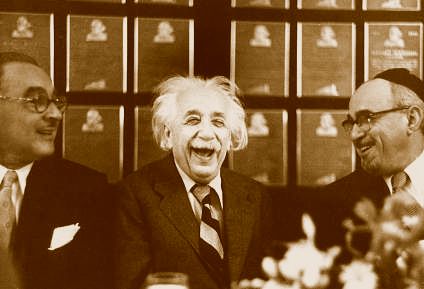
As Israeli diplomat Abba Eban noted about the General Assembly, “If Algeria introduced a resolution declaring that the Earth was flat and that Israel had flattened it, it would pass by a vote of 164 to 13 with 26 abstentions.”

Abba Eban is to the left of jolly old Albert Einstein in this picture, taken in 1952
(click to enlarge)


The United Nations was at one time a good idea. The organization, and its Charter, remains a good idea...and the UN does some good in the world. But overall, the organization hardly deserves the pedestal many would set it upon in reality.

At the UN, genocide in Africa doesn’t get the sort of immediate, unyielding attention from the Security Council that Arab-Israeli wars do. There are two separate United Nations standards for refugees: one established just for the Palestinians (UNRWA) and one for everybody else (UNHCR). The current UN system, which time and again has been shown to be corrupt or ineffectual (look at the Iraqi Oil-for-Food program, and UNIFIL’s impotence and failure in Lebanon), is not one that we should be rushing to support.

The “United Nations” was the name the Allies fighting the Axis powers in World War Two went by.
(click on pic to enlarge WWII poster)


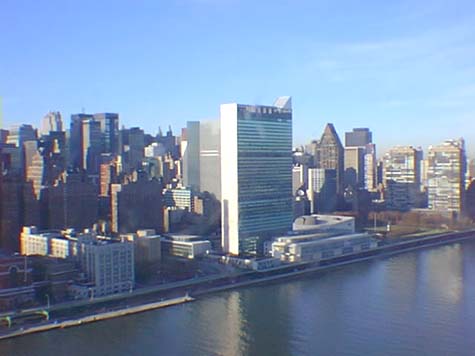
I believe that American interests would suffer at the UN if even the most polite, genial, Geneva Conventions-hugging person was the American ambassador. During the Cold War, the UN was basically a base of operations for Soviet espionage against the United States (the Russians controlled a lot more of the UN’s various offices and operations than I previously ever imagined). These days, as Pedro Sanjuan related in The UN Gang, to walk into the UN cafeteria is to walk into a room where jihad is discussed freely – not fighting it, but praising it. If there can be a more anti-American bastion in the United States other than Berkeley, California, it is at Turtle Bay, Manhattan, New York.


As long as the UN is a place where a weak-willed American presence is seen as preferable to a tough, assertive American presence, the organization – which has undeniable potential and value – will never truly change. Such a situation harms US interests more than anything else at the UN. At this moment in time, America needs an ambassador in New York like John R. Bolton, who sees through the smokescreens and games that dictatorships and developing nations put up and play when they use the United Nations’ open, “democratic” system for their own designs even as they deny their people democratic freedoms at home.

This time around, John Bolton deserves an up-or-down vote in Washington. The United States Senate would be wise to keep Ambassador Bolton in place - whatever an individual Senator's opinion of President Bush. Why?

An American ambassador to the United Nations in New York City who rightfully dispenses with utopian delusions, who can work with allies and negotiate with foes, and who does not view the UN in its current, very flawed form with rose-colored glasses, is a great asset to America, not a liability.

From that previously quoted Press Conference in New York on August 7, 2006 -

Reporter: Mr. Ambassador, how do you evaluate the Lebanese request? Do you consider them really serious and essential or they will not affect any final draft resolutions you are discussing now?

Ambassador Bolton: Well, let me just say it's not as though we drafted this resolution in a closet somewhere and suddenly sprang the text on any member government.